
HOW TO USE OUR AUTOMATED EXTERNAL DEFIBRILLATORS: As Easy As 1-2-3

Follow the AED’s voice prompts and apply the electrode pads to patient’s chest.

The AED analyzes patient’s heart rhythm and determines if shock is needed.

If shock is needed, the AED machine will instruct you to press the shock button.
American AED 101
What Does AED Stand For?
AED stands for Automated External Defibrillator
What is a Defibrillator?
An electrical device used to counteract fibrillation of the heart muscle and restore back to a normal heartbeat by applying a brief electric shock.
Today’s modern AEDs have the following in common:
How To Use
All modern AEDs are easy to use. These AEDs will instruct you with easy to follow, step-by-step verbal instructions throughout the entire rescue process.
Safety
All modern AEDs are safe to use by virtually anyone because these are programmed to deliver a shock “only” if the patient needs it.
The decision whether the patient needs the defibrillation shock or not is made by the AED and NOT by the rescuer. Therefore, even if the rescuer accidentally presses the shock button, the AED will not deliver the shock.
Electrode Pads
All electrode pads are single use only (disposable). These have a sticky gel coating that can dry out with time, that is why these have an expiration date. Check expiration date periodically and keep a second set of electrode pads as backup.
Batteries
All AEDs comes with a non-rechargeable lithium battery. Usually lasts 2 to 5 years in service and then it needs to be replaced.
Biphasic Waveforms
Early AEDs were Monophasic (less effective). All modern AEDs are Biphasic, which means, the electrical shock travels in the body from electrode pad A to pad B and then from pad B to pad A. All of our AEDs are Biphasic.
Types of AEDs
There are two types of AEDs:
Escalating Energy AED
This type of AED will automatically adjust and output (shock patient) with incremental strength of energies if needed. These types of AEDs are more efficient.
Non-Escalating Energy AED
This type of AED is not capable of escalating energy shocks and it outputs only one strength of energy.
Sudden Cardiac Arrest – Chain of Survival
The American Heart Association has defined a “Chain of Survival” and it is now widely used and followed as the critical response to sudden cardiac arrest. 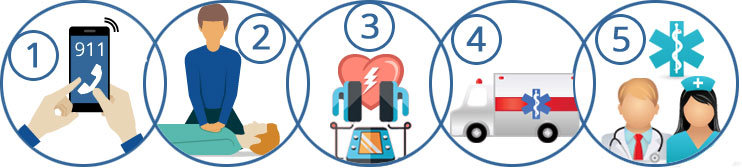
The “Chain of Survival” contains 5 lifesaving links:
- Immediate recognition of cardiac arrest and activation of the emergency response system. Call 911 or EMS as soon as possible. Locate an AED, if available, and bring it to the victim.
- Early cardiopulmonary resuscitation (CPR). Emphasize fast and hard chest rhythmic chest compressions. This will help maintain the blood flow going.
- Rapid defibrillation. This is where the AED comes in handy. Defibrillation is the only way to restart the heart.
- Effective advance life support. An emergency team should take over from here and provide advance cardiac care.
- Integrated post-cardiac care.
Following these links can greatly increase the chances of survival and recovery for victims of cardiac arrest.
Helpful AED Links
-
First Aid, CPR and Automated External Defibrillator (AED) Courses
American Red Cross First Aid, CPR and AED programs are designed to give you the confidence to respond in an emergency situation with skills that can save a life. Additional training in blood borne pathogens, oxygen administration and injury prevention can be added to CPR and First Aid training to prepare you to prevent and respond to life-threatening emergencies.
-
Cardiac Arrest and Automated External Defibrillators (AEDs)
To inform employers about the use of Automated External Defibrillators (AEDs), a life-saving technology, in the treatment of cardiac arrest at work. To provide an information resource to aid in decision-making about these devices at individual worksites.